

How To Draw White Hair On White Paper
- Negative drawing
- Examples
- Demonstration
Drawing HAIR - an introduction
Because I draw dogs I receive numerous requests about how to draw hair. This seemingly elementary exercise is in fact an virtually impossible task. Not merely do artists styles differ widely only so to do their aims. However I can at least present you with my way of cartoon hair; the techniques that conform my style and ambitions...and, even and so, I await to have left much unsaid........
Seeing is believing... only don't believe everything you see...
Which is a short way of saying y'all tin draw hair that is easily believable merely the technique may advise more detail than is actually present. There are a number of "levels" at which y'all can tackle your drawing — you might, for case....
- Choose to concentrate on the three-dimensional underlying class.
- Partially overlay the solid shading of class with a resemblance of hair and texture.
- Use the hair itself and its lighting to define the underlying class.
Whatsoever level is as valid every bit any other merely my personal preference is for the terminal of these, every bit it nearly resembles reality.
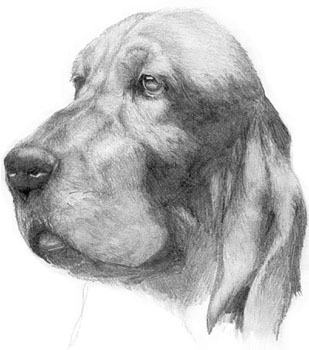
A delightful drawing of a Hound by Karen Gillies. Tonal shaping is used to define the grade of the body, which concentrates the viewer's attention on the eyes. The creative person has awarded little importance to hair particular.
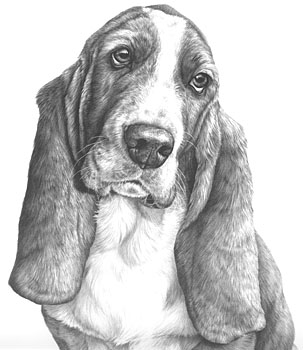
This Basset Hound drawing of mine shows the utilise of hair every bit the sole means of expressing the three-dimensional form of the body. Here the white of the eye has been carefully preserved to attract attention in that direction.
The illustration (above left) shows the utilize of global shading - treating the subject area as a single 3-dimensional object without surface texture and applying an overall scheme of tonal values. In giving visual priority to the underlying class, the presence of hair is left almost entirely to the viewers imagination.
In drawing the Basset (above right) I have used local shading - computing the light reflection of each pilus, or lock of hairs, as it is drawn and applying the required tones. No global shading exists merely all local shading is adjusted with reference to its position within the whole subject. In this case priority has been given to the outward advent - 3-dimensional form is described merely by the hair, its texture and surface highlighting.
It'south non all black and white...
If everything "black" was really black and everything "white" was pure white nosotros would meet goose egg except flat, featureless shapes with abrupt outlines. But zippo in life is so uncomplicated - in reality reflections and absorbance of lite play a total part in what we see. Information technology's the highlights and shadows of a Blackness Labrador's glossy glaze that tell us what shape the dog is - the underlying structure is never overtly seen. The hair, merely the pilus, defines its three-dimensional form. The same is truthful of a white Poodle except that the emphasis is reversed - the shadows play a greater role than the highlights. But at that place is also one other aspect that is as true for each in the cartoon process......
A PENCIL MARK IS NOT A Pilus
I cannot stress this too much or too often — Pencils exercise not draw hairs. Pencil marks only define the position and shape of hairs. Well, that may be a little too simplistic - there volition exist occasions when a dark hair overlays a patch of white hair and requires a positive pencil stroke. And pencils certainly add the required tonal values to hairs. But in general use a pencil line does non correspond a hair — it forms the boundary between hairs.
Negative and Positive...
Drawing hair is virtually positive and negative drawing (see introduction to negative drawing) and each has to exist understood in its ain right before you lot can effortlessly combine the ii and reproduce pilus with a sense of reality.
As I stated above, we encounter black hairs because of their highlights; white hairs are outlined past their shadows. In both cases the hairs are visible because of their "negative" backdrop. In practise you create not the hair simply the shadow or highlight. For black hair the highlight will range from brilliant, white through a series of darkening greys only not, notwithstanding, to blackness - the darkest tones available must be reserved for the positive shadows that define the edges of black hairs not for hairs themselves.
This is the cardinal to negative drawing; the technique that you must learn - as yous work, focus your total attention not on the actual lines you are drawing but on the spaces in between them. In mutual with watercolour painting, the only white available to the Graphite Artist is the white of the newspaper. To produce a white line you lot must therefore define that line by outlining information technology in a darker tone. The line yous are drawing has no importance in itself. It is the space betwixt the lines that is paramount.
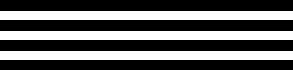
Are these black lines on white or white on black?
If these are black lines drawn on white paper and so
the drawn lines are positive marks.
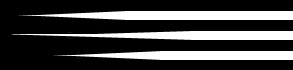
White lines on black? They announced to be so considering
the black defines their boundaries. The black is drawn solely to create the white. This is negative drawing.
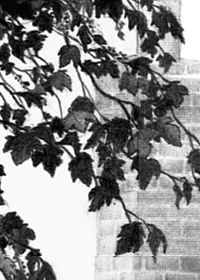
The foliage is an instance of positive drawing. The pencil lines provide the dominant marks.
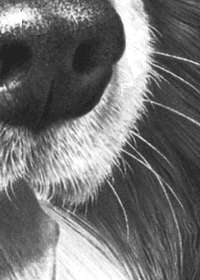
An example of negative drawing. The pencil lines serve but to define the dominant white hairs.
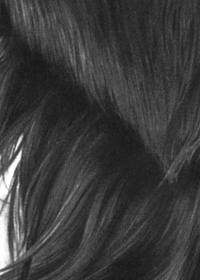
A combination — The positive-drawn shadow is extended both up and down into the bordering negative-fatigued areas.
How is this achieved?
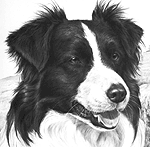 Wherever possible, I work from dark into lite. From a purely practical point of view information technology is far easier to graft later drawing onto a dark area of tone. This enables me to use it as a break - to draw away in i direction and so to render and continue in the reverse direction. The ear shown above-right (and the 1 I am about to demonstrate with) is the left-hand ear of this beautiful Border Collie. I would work this area in 4 distinct stages....
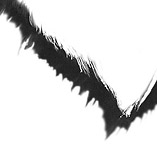 Stage ane: Having found my black shadow area from which to work, the shadow is roughly established and the top border carefully drawn up into the area above to define the lighter hairs. Remember, I'm drawing the shadows between the hairs here. The white "hairs" are left white until the next phase.
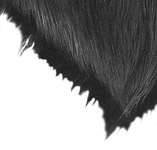 Stage 2: Working from dark to light, the ear flap is fatigued back down into the shadow. This is negative drawing as I'm cartoon the shadows betwixt the hairs and not the hairs themselves. Once the hairs are divers, tone is applied, and the lighting continually adjusted, to describe their correct three-dimensional shaping. (see "Cartoon Grass").
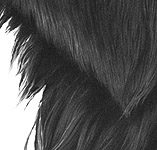 Phase three: New drawing is grafted onto the nighttime shadow as it is extended down into the area below. If some of the lite hairs demand to become support into the shadow this can be accomplished with Blu-Tack or kneadable eraser - a line of graphite removed from the shadow is redefined and blended into the light line below.
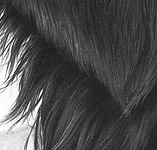 Stage 4: The negative-fatigued highlights are closed by bringing the 2 outside boundary lines together into ane. These at present form i positive line that is fatigued to a bespeak to complete the finish of each pilus.
Conclusion...
Working one small area at a time will make your overall project far easier to handle both mentally and physically and will go on you firmly in control. Don't be tempted to piece of work on the whole cartoon at once and nor should you effort to fill whole areas with tone. Well, Yes - I know your drawing will expect more than consummate far more quickly... and you may experience that information technology'southward helping y'all plant form but beware - the bright highlights you may later wish to create will no longer be doable, resulting in a distinct loss of life and tonal depth.
Decide on the light direction, consider the position of every pilus you lot define and and then apply the illumination accordingly. Defining your hairs then calculating and adding specific local tone will requite them an enhanced reality — don't use global toning and hope information technology will piece of work locally.
TOP TIP
When taking photos equally source material always use color film. Yous'll need colour to follow detail through areas of shadow and you lot'll need to empathise the differences betwixt areas of similar tone. But above all - colour film won't dictate your choice of tones - you stay in control.

Source: https://sibleyfineart.com/tutorial--draw-hair.htm
Posted by: strongpressessidow1985.blogspot.com
0 Response to "How To Draw White Hair On White Paper"
Post a Comment