

How To Draw A Cylinder In Matlab If Radius And Height Are Known
Node shape cylinder in TikZ
Cylinder shape is a function of the shapes.geometric TikZ library, so to piece of work with this shape, we need to declare the library. We demand to add together the following piece of code after the TikZ bundle announcement:
\usetikzlibrary{shapes.geometric} A cylinder shape can be drawn by using the option cylinder to the \node command. The following code creates a cylinder node named (c) at coordinate (0,0).
\documentclass[edge=0.2cm]{standalone} \usepackage{tikz} \usetikzlibrary{shapes.geometric} \begin{document} \begin{tikzpicture} \node[cylinder] (c) at (0,0) {}; \end{tikzpicture} \end{certificate} Compiling this line of code displays nothing. The cylinder node will be drawn just if we provide depict choice to the node control as follows:
\documentclass[border=0.2cm]{standalone} \usepackage{tikz} \usetikzlibrary{shapes.geometric} \begin{document} \begin{tikzpicture} \node[cylinder, draw] (c) at (0,0) {}; \end{tikzpicture} \stop{document} 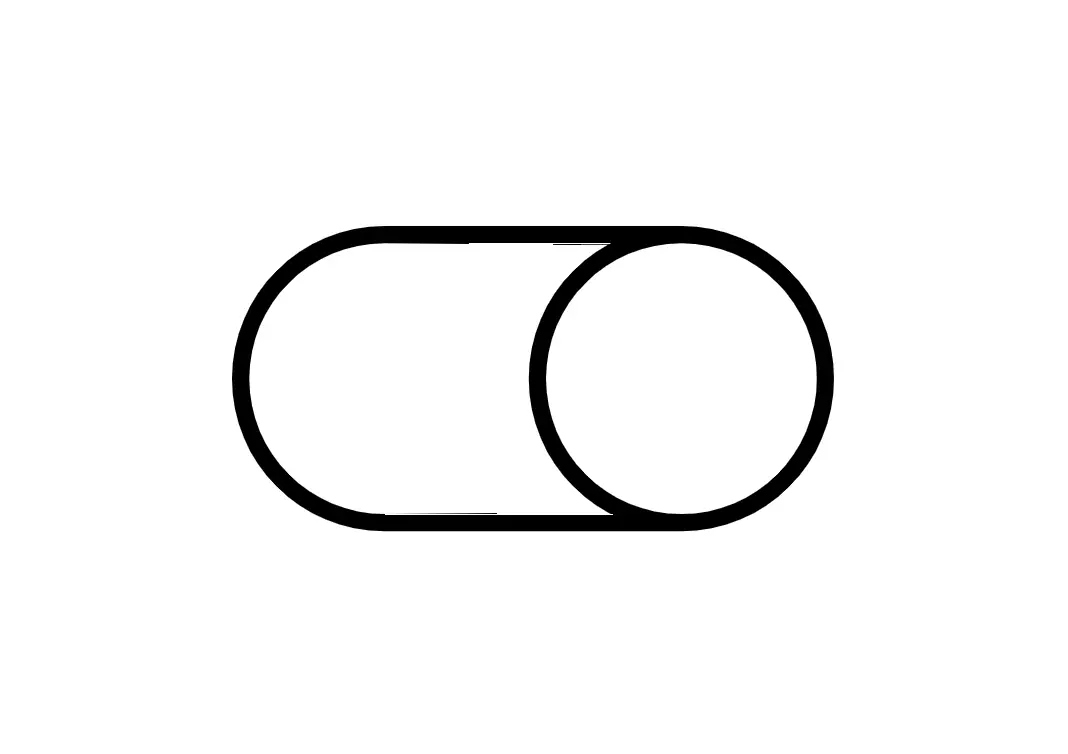
Add together text to the cylinder node
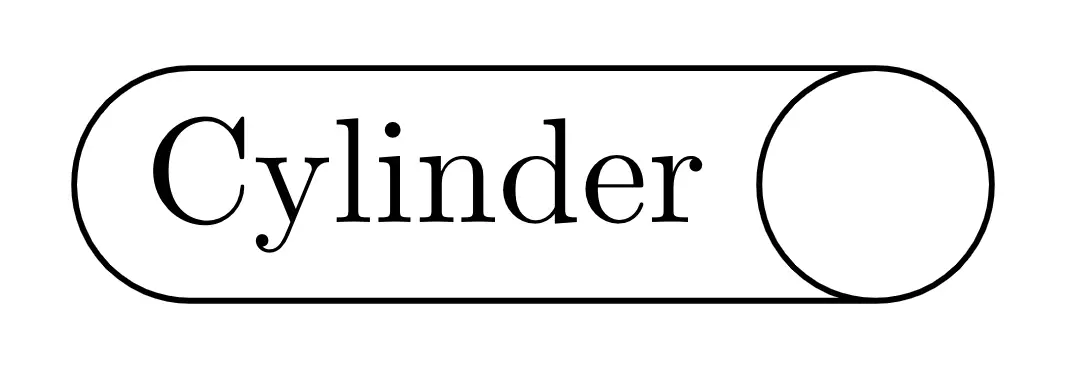
The previous code creates a cylinder node with empty content. Text can be added within the cylinder node by putting it betwixt the curly braces {} as follows.
\documentclass[border=0.2cm]{standalone} \usepackage{tikz} \usetikzlibrary{shapes.geometric} \brainstorm{document} \brainstorm{tikzpicture} \node[cylinder, describe] (c) at (0,0) {Cylinder}; \end{tikzpicture} \stop{certificate} To fit the text inside the shape, this line of code yields to a cylinder with a size depends on its content:
Change text colour of the cylinder node
In the previous section, we accept added content to the cylinder node and now we would similar to change the text color. This tin be achieved past providing the option text = <color> to the \node control:
\documentclass[border=0.2cm]{standalone} \usepackage{tikz} \usetikzlibrary{shapes.geometric} \begin{certificate} \brainstorm{tikzpicture} \node[cylinder, draw, text = imperial] (c) at (0,0) {Cylinder}; \end{tikzpicture} \finish{document} 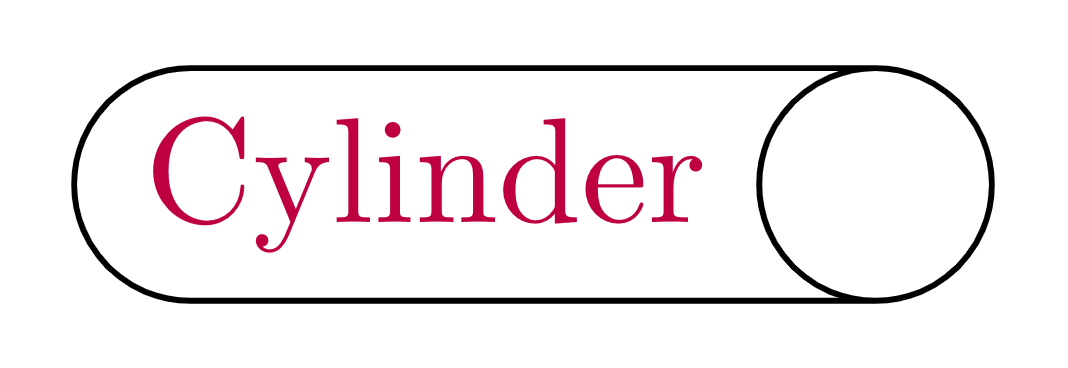
Add filling color to a node
The cylinder node tin can be filled with any colour using the option make full = <colour>. Here is an illustrative case of a light magenta filling with our purple text:
\documentclass[border=0.2cm]{standalone} \usepackage{tikz} \usetikzlibrary{shapes.geometric} \begin{document} \brainstorm{tikzpicture} \node[cylinder, draw, text = purple, fill = magenta!20] (c) at (0,0) {Cylinder}; \terminate{tikzpicture} \terminate{document} 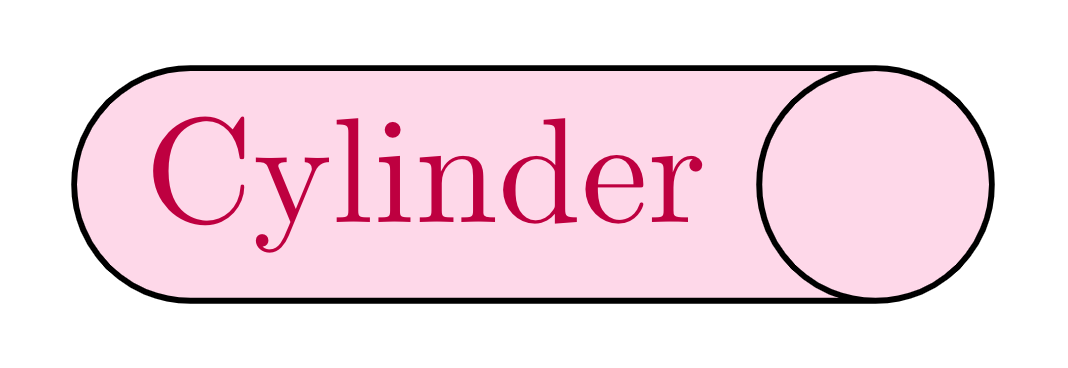
Hither, we will fill the cylinder torso with the same light tone of magenta, and the terminate part with a darker tone of magenta than the body.
\documentclass[edge=0.2cm]{standalone} \usepackage{tikz} \usetikzlibrary{shapes.geometric} \begin{document} \brainstorm{tikzpicture} \node[cylinder, describe, text = regal, cylinder uses custom fill, cylinder trunk fill = magenta!10, cylinder end fill up = magenta!40] (c) at (0,0) {Cylinder}; \end{tikzpicture} \end{document} 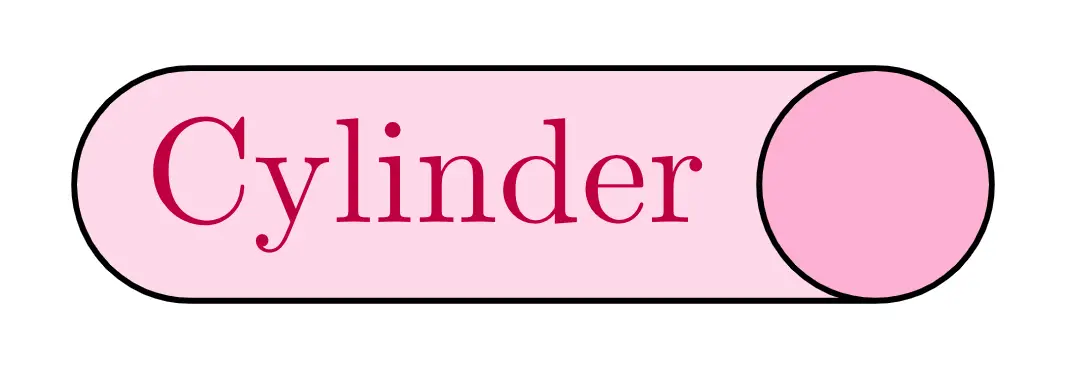
Change the border line colour of a node
The cylinder border color tin can be modified (default is blackness) by providing the color name to the describe selection draw = <colour>. Here is an instance of a cylinder filled with light magenta, has regal text and violet borders:
\documentclass[edge=0.2cm]{standalone} \usepackage{tikz} \usetikzlibrary{shapes.geometric} \begin{document} \begin{tikzpicture} \node[cylinder, draw = violet, text = purple, cylinder uses custom make full, cylinder trunk fill = magenta!10, cylinder end fill = magenta!xl] (c) at (0,0) {Cylinder}; \end{tikzpicture} \stop{document} 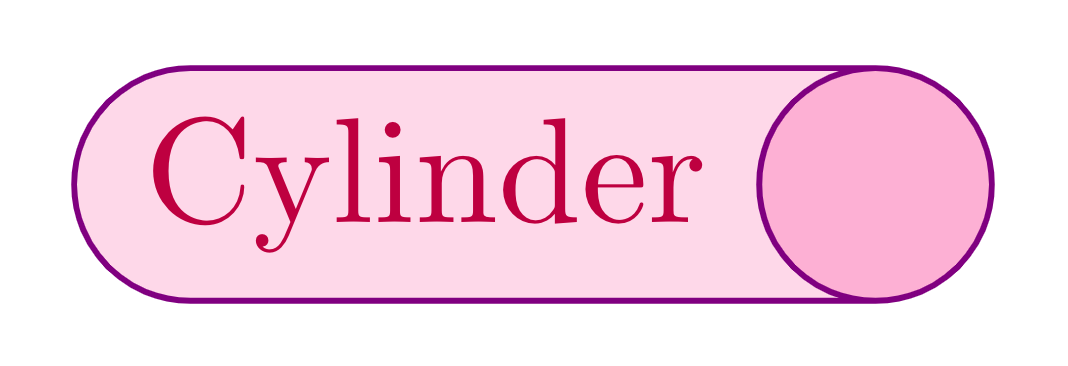
Change the size of a cylinder node
We mentioned higher up that the size of a cylinder depends on its content. This is always true and we can set only the minimum size of a cylinder. We can suit a minimum size for its width with minimum width option, and similarly, we tin set its pinnacle by using minimum height option. For a cylinder shape, width is the altitude between the straight sides and height is the distance between the curly sides. Below, we set the minimum width value to 1 cm and the minimum height value to two.5 cm.
\documentclass[edge=0.2cm]{standalone} \usepackage{tikz} \usetikzlibrary{shapes.geometric} \begin{document} \begin{tikzpicture} \node[cylinder, draw = violet, text = purple, cylinder uses custom fill up, cylinder body fill up = magenta!10, cylinder finish make full = magenta!40, minimum width = 1cm, minimum height = two.5cm] (c) at (0,0) {Cylinder}; \stop{tikzpicture} \finish{document} 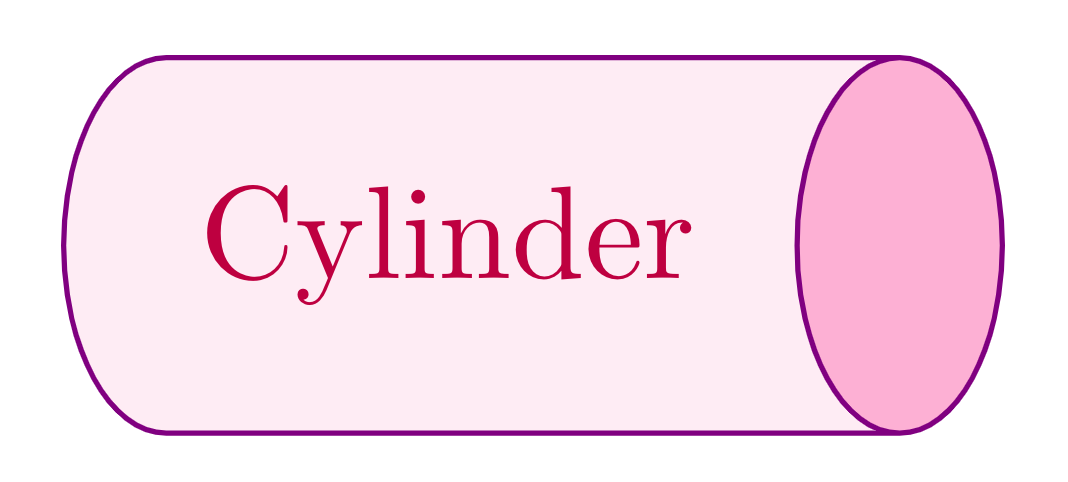
If we demand both the width and the length sizes to be the same, we can apply minimum size option. Following line of code sets both the sizes to 2 cm.
\documentclass[edge=0.2cm]{standalone} \usepackage{tikz} \usetikzlibrary{shapes.geometric} \begin{certificate} \brainstorm{tikzpicture} \node[cylinder, draw = violet, text = purple, cylinder uses custom make full, cylinder trunk fill = magenta!10, cylinder end make full = magenta!twoscore, minimum size = 2cm] (c) at (0,0) {Cylinder}; \finish{tikzpicture} \terminate{certificate} 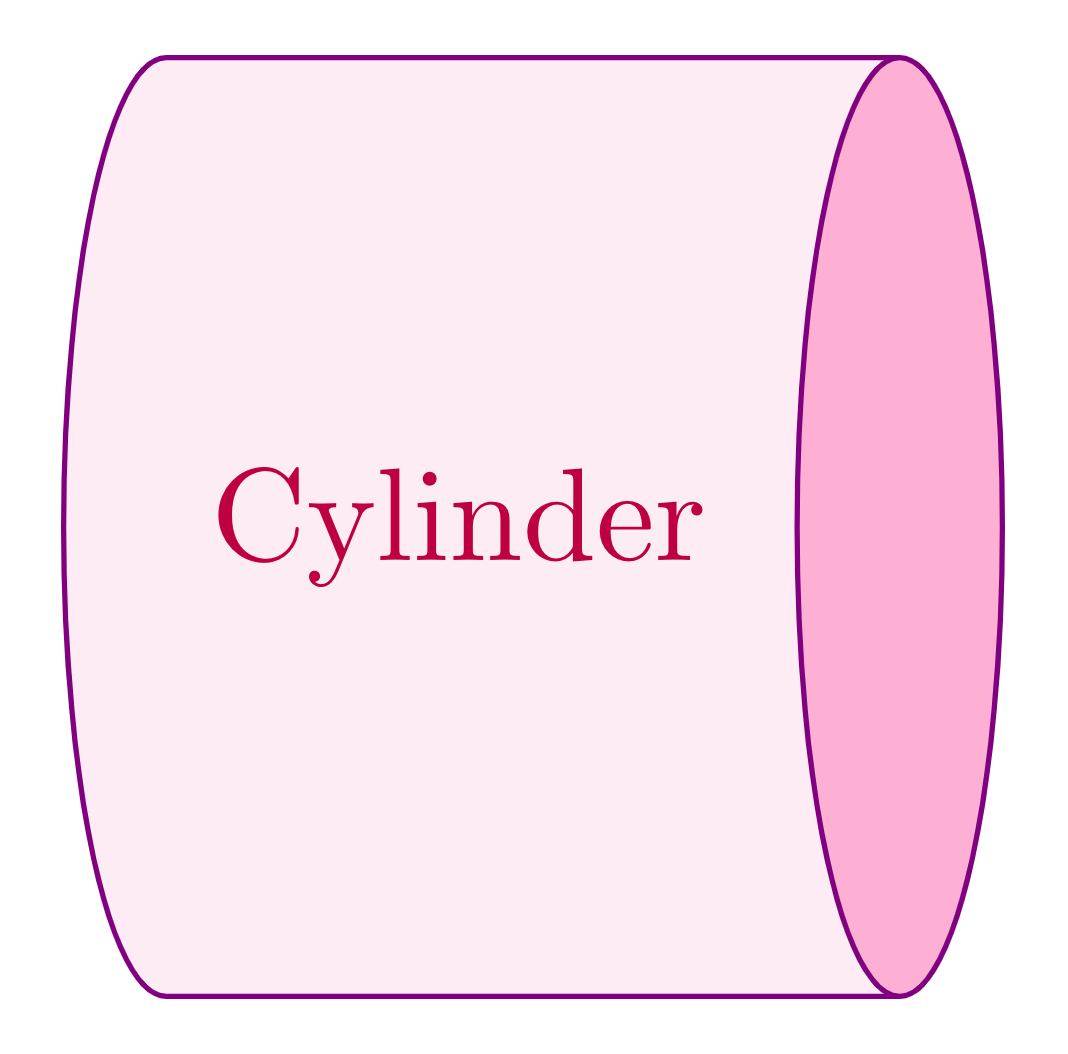
\documentclass[edge=0.2cm]{standalone} \usepackage{tikz} \usetikzlibrary{shapes.geometric} \begin{document} \begin{tikzpicture} \node[cylinder, depict = violet, text = purple, cylinder uses custom fill up, cylinder body fill = magenta!10, cylinder end fill = magenta!twoscore, attribute=0.25] (c) at (0,0) {Cylinder}; \stop{tikzpicture} \end{document} 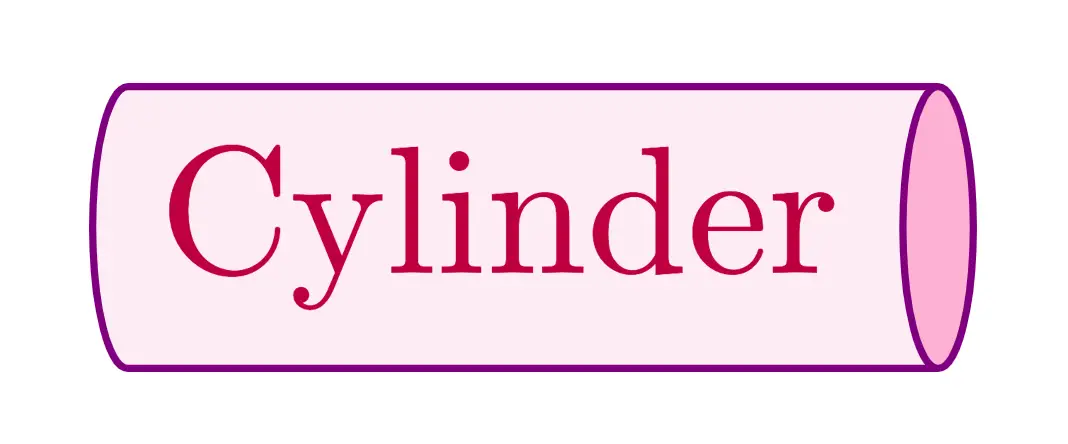
Rotate thecylinder shape
In some cases we might need a continuing cylinder. We can rotate the cylinder node shape without rotating its contents with shape border rotate option. Hither is an example of a 90 degrees rotated cylinder, with an aspect of 0.two.
\documentclass[border=0.2cm]{standalone} \usepackage{tikz} \usetikzlibrary{shapes.geometric} \begin{certificate} \begin{tikzpicture} \node[cylinder, draw = violet, text = royal, cylinder uses custom fill, cylinder body fill = magenta!ten, cylinder end fill = magenta!40, aspect = 0.2, shape border rotate = 90] (c) at (0,0) {Cylinder}; \end{tikzpicture} \end{document} 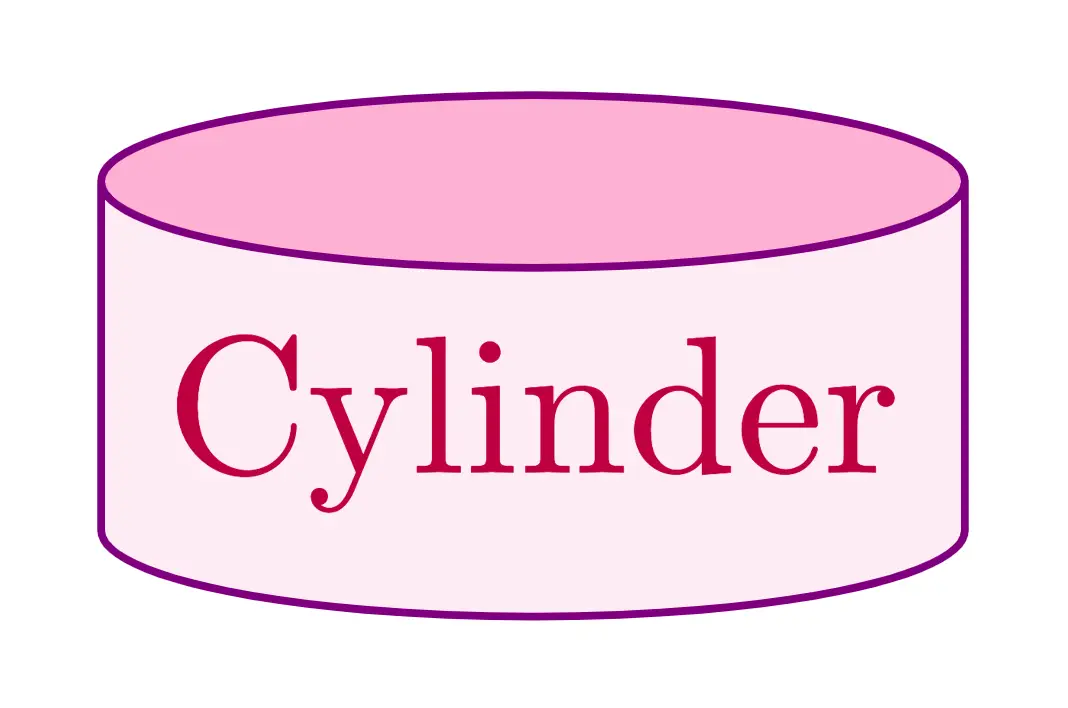
Anchors of a cylinder node
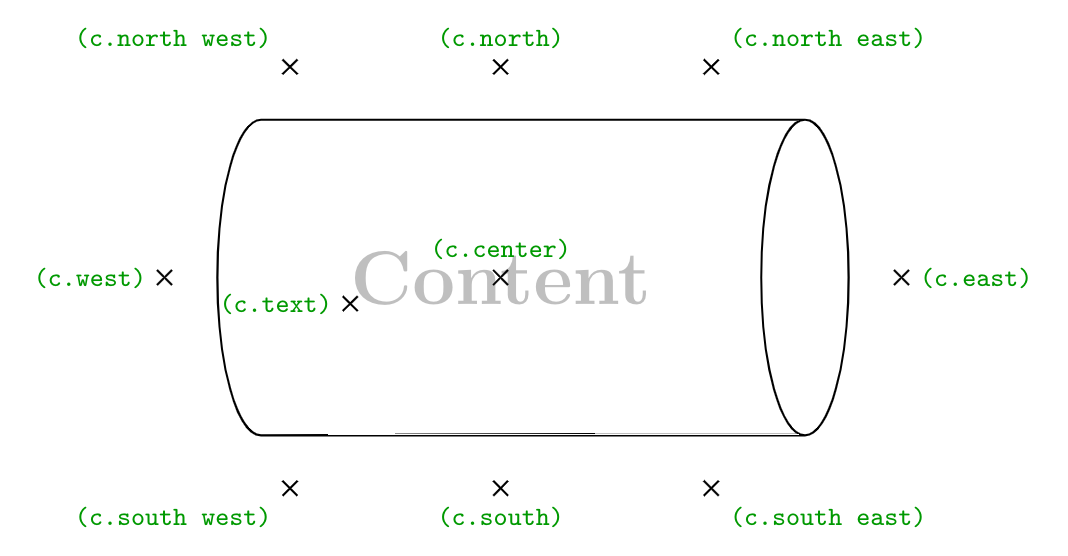
The reward of using a node cylinder is that information technology defines a fix of anchors that we can use to get coordinates of the node borders or to position nodes with accurateness with respect to given coordinates. Past default, node center is positioned at the provided coordinates ((0,0) for the previous examples).
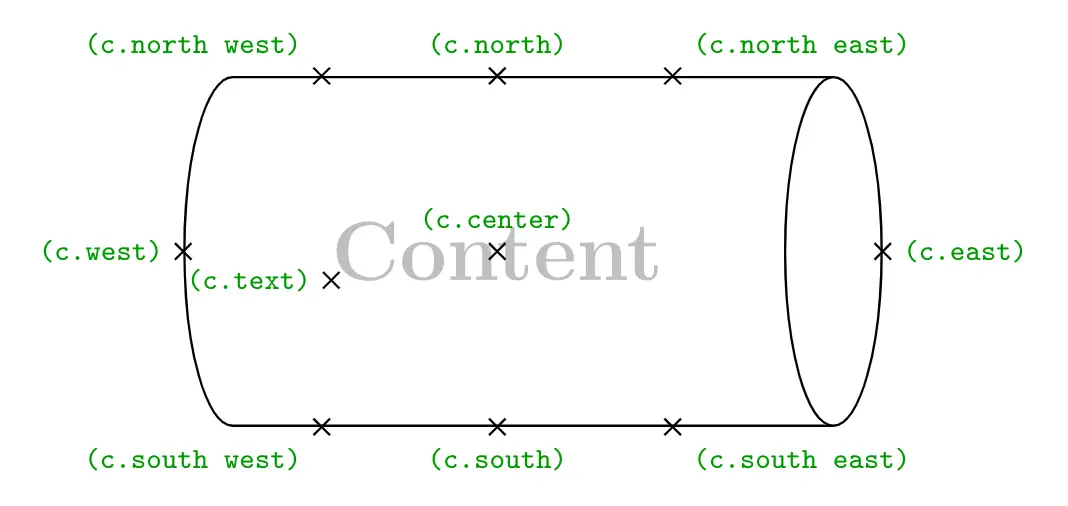
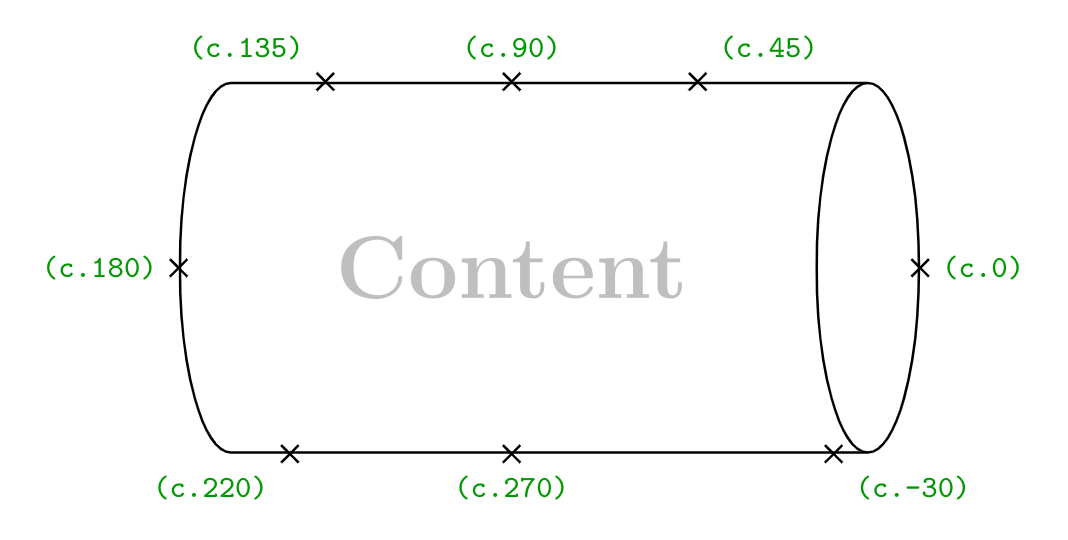
Outer separation
The above anchors can exist moved exterior the node border by adding outer sep = <value> to the node command. Here is an example of anchors moved exterior the node edge with 10pt.

Source: https://latexdraw.com/cylinder-shape-in-tikz/
Posted by: strongpressessidow1985.blogspot.com
0 Response to "How To Draw A Cylinder In Matlab If Radius And Height Are Known"
Post a Comment