

How To Get A Youtube Channel Shut Down
Why was my video removed?
The reason for the removal of a video is usually mentioned in the electronic mail that YouTube sends to the account holder regarding the removal. If yous didn't receive an email from YouTube, check your spam folder and check that the e-mail address for your YouTube account is electric current. The message also should announced in your YouTube account, so check in that location as well.
Terms of Service Violation
These removals unremarkably accept zippo to do with copyright. Instead, they by and large result when a video is flagged as containing nudity, complimentary violence, or otherwise in violation of YouTube's Terms of Use or Community Guidelines. The Terms of Service too state that "YouTube reserves the right to remove Content and User Submissions without prior notice," so YouTube takes the view that it tin can remove a video for any reason it likes.
For more information about these Terms of Service removals, meet YouTube'south help pages. Sometimes, if you ask nicely, YouTube may review and reconsider the removal, although we are non aware of a formal process for this.
Content ID Match
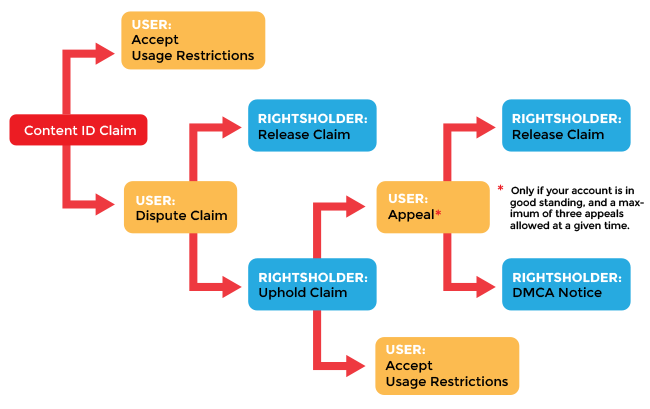
Many videos trigger a response from YouTube'south "Content ID tool" (likewise sometimes called the Video ID tool). According to YouTube, this organization enables "copyright holders to easily identify and manage their content on YouTube." It works by checking every video uploaded against a database of audio and video "fingerprints" submitted by rightsholders. So when you upload a video, the Content ID tool tin spot a vocal snippet used in that video, even if you never mention the proper name of the song or performer in the video description or title. You'll know if your video has been matched because a annotation will appear next to the video on the "My Videos" folio.
The rightsholder gets to decide what happens when there is a friction match past setting "usage restrictions" — it can elect to Block, Track, or Monetize (i.e., put ads effectually the video and become a portion of the revenues). Major music labels take mostly opted for the "Monetize" approach. In most cases, no homo looks at the videos — YouTube'south computers spot the friction match and apply the "Block" usage policy automatically.
This tool created by YouTube can help y'all determine in advance whether a rightsholder might seek to cake or monetize your video.
DMCA Takedown Observe
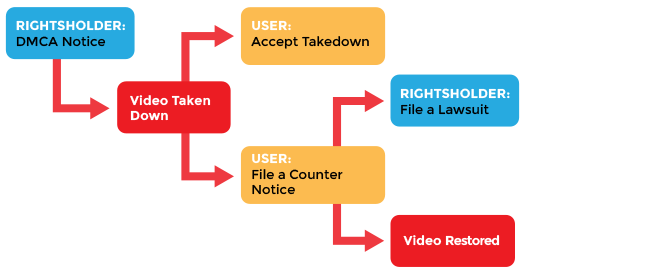
DMCA takedowns normally upshot from formal notices of copyright infringement from rightsholders to YouTube about your video.
Equally part of the Digital Millennium Copyright Act of 1998 (DMCA), Congress granted online service providers (similar YouTube) certain protections from copyright infringement liability, and then long as they see certain requirements. One requirement of this "DMCA condom harbor" is that online service providers must implement a "discover-and-takedown" system. Another requirement is that YouTube must cancel the accounts of "echo infringers."
That's why, when YouTube receives a formal DMCA takedown notice from a rightsholder, information technology removes the video. Information technology also puts a "strike" on your business relationship, and requires yous to complete a mandatory session in its online "Copyright School." Once you accumulate three "strikes" on your business relationship, YouTube volition cancel all of your YouTube accounts, taking downwardly all of your videos and refusing to allow y'all back as a YouTube account holder.
A proper DMCA takedown notice must meet certain requirements, such as identifying the infringing cloth clearly and specifically, and stating that the sender has a 'good faith belief' that the material actually infringes copyright. Likewise often, nevertheless, we have run across improper notices and/or takedowns based solely on keywords or a purely automatic process.
If y'all larn that your video has been targeted under the DMCA, be sure to ask for a copy of the notice if information technology was not already forwarded to you.
YouTube's "Contractual Obligations"
YouTube has fabricated agreements with sure rightsholders where special privileges have been granted allowing rightsholders to remove content every bit they meet fit. If your video has been removed for this reason, YouTube will inform you and provide the contact information of the rightsholder to discuss the removal.
Getting Your Video Restored
Next we'll hash out information that will aid you decide whether to ship a dispute or counter-notice.
Disputing a Content ID Removal. If your video was removed thanks to a Content ID match, information technology'south quite possible that no man at the rightsholder's part has ever seen your video. The fingerprint matching is done by YouTube's computers, and generally the blocking is done automatically. When yous submit a dispute, however, the rightsholder is notified and your video goes into their "review" queue.
In other words, sending a dispute might well trigger the first man review of your video. Ask yourself what those who are employed past the rightsholder are likely to think when they encounter your video. Will they put it into the "let it slide" hopper, or make it a priority to remove? While it's impossible to predict what policies or sensitivities any detail rightsholder might have in identify, there are a few things to proceed in listen.
- Start, the review staff are likely to take a dim view of verbatim, unedited copies of their works. That's the stuff that they call "piracy."
- 2nd, rightsholders are often sensitive well-nigh uses that, if they became widespread, would cut into an existing or anticipated revenue stream. For example, the music industry is used to getting paid when 1 of its songs is used in a car commercial. If you are posting a video advertisement for your business on YouTube, and using a vocal equally the soundtrack, some in the music industry may worry that your employ is usurping the business of licensing songs for use in Net video ads.
- Tertiary, some rightsholders tin be sensitive about videos that criticize, parody, or mix their content with unexpected themes. Of course, these may also be precisely the situations where fair apply (see beneath) and the Starting time Subpoena should protect the video. Nevertheless, some rightsholders may want to silence this kind of expression and may exist willing to use DMCA takedowns, even if improper, to exercise and then.
If your video was matched by the Content ID tool, you can submit a "dispute" and get it put back up. This tin can be done from the "copyright notices" section for your videos and requires you to answer a few questions. Once yous submit a dispute, rightsholder tin can uphold the Content ID claim and decline the dispute, or release the claim. At this stage, if your account is in good standing with YouTube, yous can entreatment the rejected dispute with a maximum of three appeals at whatever given time. The rightsholder can then either release the claim on the video, or issue a DMCA takedown observe (more on that below). A rightsholder has 30 days to review a Content ID dispute, and thirty days to answer to an appeal of a rejected dispute.
Instead of filing an firsthand copyright takedown in response to a Content ID appeal, rightsholders tin take advantage of a YouTube "feature" that allows them to schedule takedowns of videos. If a user receives a scheduled (or delayed) takedown observe notification from YouTube, they have 7 days to cancel their Content ID appeal, which will consequently keep the rightsholder merits active on the video. This is ostensibly washed to help users avoid copyright takedowns that can lead to strikes on their channels. Even so, information technology'southward another step in an already onerous and intimidating process that users have to follow to in order to preserve their lawfully uploaded content.
Information technology is of import to keep in listen that at any phase in the procedure of disputing a Content ID claim, rightsholders tin initiate the DMCA takedown process, or sue you. If they exercise sue you, though, the cost of defending yourself could exist considerable, and if you lose it's possible you could be on the claw for amercement and even the rightsholder'due south attorneys' fees.
To sum upward, if your video was removed by the Content ID tool, and you make up one's mind to dispute the removal, you volition have tweaked the rightsholder's tail. Sometimes the rightsholder will decide that your video wasn't the kind of thing information technology meant to remove, and just leave the video alone. If, on the other mitt, the rightsholder really wants the video to stay downward, the easiest and cheapest mode to accomplish that is to transport a DMCA takedown notice.
Sending a DMCA Counter-detect.
If your video was removed past a DMCA takedown notice, you tin submit a "counter-notice". In guild to be valid, still, the counter-notice must include your contact data, a signature, a argument under penalty of perjury that the "fabric was removed or disabled as a result of a mistake or misidentification," and your consent to the jurisdiction of your local federal court (if the rightsholder elects to sue you). Unless the rightsholder files a copyright infringement lawsuit against y'all inside 2 weeks of receiving your counter-notice, your video will be restored and the "strike" removed from your account. If the rightsholder does sue, your video stays down until the lawsuit is resolved.
In addition, every DMCA takedown notice that is sent regarding one of your videos counts as a "strike" on your business relationship. If your business relationship accumulates three strikes, YouTube will cancelall of your accounts and remove all of your videos. The just way to remove a strike is to send a formal counter-notice.
When y'all ship a counter-find to YouTube, yous go out the rightsholder with two choices — either allow the video to be restored after 10 business days, or sue you to keep it down (the rightsholder could contact you lot and enquire you to withdraw your counter-notice before suing, just is not required to do so). This is consequently a higher stakes game than disputing a Content ID removal, because the rightsholder does not have a inexpensive and fast style to keep the video down, short of suing you. We recommend that users research copyright police and consult a qualified attorney before sending DMCA counter-notices.
Disputing a Contract Claim
Under these anti-user agreements, the usual means to dispute rightsholder claims are not bachelor. In many instances, even if you successfully submit a DMCA counter-notice, the video volition non be reinstated. These agreements are opaque, and scope of what'southward allowed under them is unknown. They may be short-term, or long-term.
Off-white use is dealt a serious accident under these agreements.
Deciding Whether to Challenge a Takedown
Because disputing a takedown can have potentially serious legal consequences, yous should practice care in deciding what to do. The following is intended to provide general data, and is not legal advice. We encourage you to contact a qualified lawyer if y'all intend to dispute or counter-detect to restore a video.
The first consequence you might consider is whether the claim might be right. Does your video use copyrighted material? Do you lot have a right to employ that material? In that location are many circumstances where copyright law allows you to borrow from pre-existing works owned by others. The well-nigh important of these are addressed past a legal doctrine known as "off-white use," which excuses activeness that might otherwise constitute copyright infringement. In evaluating whether something is a fair utilize, courts generally consider four factors:
- the nature of your use (transformative works are more than likely to be off-white uses, as are noncommercial works);
- the nature of the copyrighted work (you take more fair utilise leeway with factual works like news stories than purely creative works);
- the amount taken from the copyrighted work (this is both a quantitative and qualitative inquiry); and
- the upshot on the market place for or value of the piece of work.
No i cistron is dispositive, and the cases say that all the issues need to be considered together, rather than simply calculating a win-loss record on the four factors.
Fair apply is a big topic. Fortunately, at that place are splendid resource online that explain information technology in more detail (east.g., Stanford's Copyright and Off-white Use Eye, Chilling Effects, the Fair Use Network, the Center for Social Media).
For nearly YouTube videos, still, a good place to begin your analysis is to ask the following questions:
- Is my video transformative? Is it noncommercial?
- Is my work a substitute for the original? Will people still want to purchase the original after seeing my video?
- How much of the original piece of work did I take, both quantitatively and qualitatively?
- Was the purpose of my employ noncommercial, educational, for the purpose of inquiry?
- If my employ were to get widespread, would it harm the marketplace for or value of the original work
I Think What I Did Was Lawful, What Else Practise I Need to Consider?
Many people faced with a takedown are looking for the answers to two more questions:
- If I dispute or counter-notice, will I get sued?
- If I were sued, would I win?
Those can exist hard questions to answer, because videos are different, rightsholders are different, and cases are dissimilar. These are questions to hash out with a qualified lawyer.
Permit's start with two facts:
- If your video incorporates copyrighted material owned past someone else (like a clip taken from a movie, TV show, or song performed or written by someone else), the rightsholder could sue you at whatsoever time. They don't have to warn you lot offset, they don't have to use the Content ID tool, they don't have to send a DMCA takedown notice.
- It is very rare for a typical YouTube user to be sued past a major entertainment industry company for uploading a video. We have heard of a couple special cases, involving pre-release content leaked by industry insiders, only those aren't typical YouTube users. And there have probably been a few lawsuits brought by aggressive individual copyright trolls. That's right — millions of videos accept been posted to YouTube, hundreds of thousands taken down past major media companies, just those companies take not brought many lawsuits confronting YouTube users.
And then, while a lawsuit is always a possibility to be taken seriously, it is non as if the amusement industry has launched a mass lawsuit entrada against YouTubers. Of grade, that could alter (meet, e.yard., what the music business organisation did to P2P file sharers). But when yous dispute or counter-find, yous are calling attending to yourself, and its a good idea to be confident most your legal position and risk.
If I Do Get Sued, What Then?
If yous suspect that there is a possibility that y'all could be sued, but you desire to dispute or counter-notice anyway, that would be a skillful time to seek specific legal communication (yous may contact EFF, although nosotros cannot promise to be able to help anybody). Just here's some full general data.
Lawsuits are Expensive. Litigation is a very expensive undertaking in our civil justice system. Nether copyright law, a court may forcefulness the losing side to pay the winning side'due south attorneys' fees, merely it is not mandatory. And so even if you win, you lot might exist left to foot your own legal bills. (Fortunately, some lawyers, including EFF, will take cases on a pro bono footing, but there are many more than deserving defendants than there are pro bono resources to defend them.)
What If I Lose?
Copyright constabulary provides a prevailing political party with a variety of remedies, including actual amercement (how much money did the rightsholder lose due to your video) and disgorgement (whatever profits you made). If the copyrighted work was registered with the Copyright Role before the infringement began (most major media companies register their TV programs, movies, songs, etc.), the rightsholder may be eligible for an award of their attorneys' fees (which tin can quickly mount to be greater than whatever damages award), and can also opt for "statutory damages," where the court imposes a fine of anywhere between $750 and $xxx,000 (and up to $150,000 for willful infringements) per piece of work infringed.
More Resource
- YouTube on Content ID and Fair Use
- YouTube'due south Copyright Tips
- YouTube's Help Center Copyright page
- Code of All-time Practices in Fair Utilise for Online Media
Source: https://www.eff.org/issues/intellectual-property/guide-to-YouTube-removals
Posted by: strongpressessidow1985.blogspot.com
0 Response to "How To Get A Youtube Channel Shut Down"
Post a Comment