

How Do You Draw Double Bonds In Wedge And Dash
Drawing and Agreement Diagrams
The ability to draw and interpret the different diagrams that are used to stand for the unlike conformations is a very of import skill to acquire. It will probable require that you maximise your artistic skills! The only person that will exist decieved by your poor diagrams is you! Your teacher(s) volition exist able to tell instantly that you are struggling, don't know or are trying to hide that y'all don't really know.
Nosotros demand these diagrams because molecules typically have 3D shapes associated with them and we need to be able to accurately depict those 3D shapes on a 2d page (newspaper or screen). I n many ways this is similar to the way we look at the plans for a firm or a Lego kit where we use those plans to create that object exactly as intended. The different types of diagrams each have a specific feature that defines the manner they need to be drawn and interpretted. This then allows for the unambiguous interpretation of those diagrams. It is these features that are important to know and understand.
| | | Newman | | |
Wedge-hash diagrams
Wedge-hash (or wedge-dash) diagrams are the most common representation used to show 3D shape equally they are ideally suited to showing the structure of sp3 hybridised (tetrahedral atoms). They are rarely needed for sp2 (due east.g. alkenes) or sp systems (e.chiliad. alkynes).
Wedge-hash diagrams are usually drawn with two bonds in the aeroplane of the page, one infront of the plane, and ane behind the plane. This gives the molecule 3D perspective: we envisage the assuming lines being closer to usa and the hashes fading away in the background.
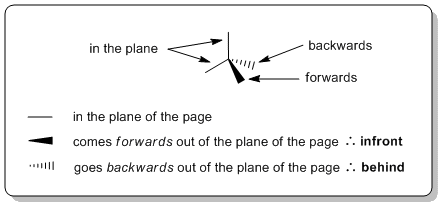
When drawing wedge-hash it is a good idea to visualise the tetrahedral arrangement (or the advisable geometry) of the groups and try to brand the diagram wait like this. It is worth looking at the drawing and asking yourself does it brand geometric sense ? Can yous run into the shape yous are trying to depict ? If the respond to that question is "no", then the diagram is inadequate and should be redrawn.

Equally a suggestion, they seem to be most constructive when the "like" pairs of bonds (2-in-aeroplane, ii-out-of-plane) are next to each other, as shown in the left box higher up.
Here are some other examples to review:

Recall that diagrams are being used to nowadays the required data efficiently. Organic chemists use line diagrams to represent structures equally role of the symbolic code because they are quicker and easier to describe as we tin can just get out out the C atoms and the H attached to those C atoms because we know to just assume that they are in that location. This idea also carries over into wedge-hash diagrams. A common scenario is shown below where the bail to an H has been omitted and it is assumed that nosotros know that information technology is there.

Sawhorse
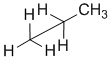
Sawhorse diagrams are like to wedge-dash diagrams, but without trying to use "shading" to denote the perspective. The representation of propane shown below has been drawn so that we are looking at the molecule which is below u.s.a. and to our left.
Newman Projections
 Newman projections are drawn by looking directly along a particular bond in the system (here a C-C bond) and arranging the substituents so that they are equally spaced around the atoms at each terminate of that bail. The protocol requires that the atoms within the central bond are shown as a dot and circumvolve as defined below. Recall of them every bit an end on view of a item bond and the showing the system of the groups around that bond.
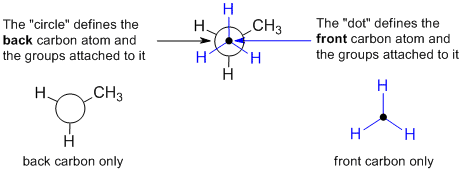
In gild to draw a Newman projection from a wedge-dash diagram, it is useful to imagine putting your "center" in line with the central bond in order to look forth it.
Permit'southward work through an example, consider drawing a Newman projection by looking at the following wedge-dash diagram of propane from the left hand side.
- First depict the dot and circumvolve to correspond the front and back C respectively
- Since the forepart carbon atom has an H atom in the airplane of the page pointing upwards nosotros tin add together that first
- The back carbon atom has an H atom in the plane of the folio pointing down
- Now add together the other bonds to each C so that information technology is symmetrical
- The groups / bonds ( blue ) that were forward of the plane of the folio in the original wedge-nuance diagram are now to our right
- Those behind ( green ) the airplane are now to our left
| | ||
| | |
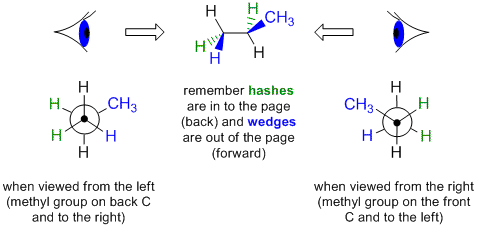
- Now y'all try the aforementioned affair, only looking from the correct to generate the other Newman projection.
Fischer Projections
Fischer projections are msot commonly used to represent biomolecules such equally amino acids and carbohydrates (sugars) as the provide a quick way of representing 1 or more multiple stereocenters. They tend to exist less ordinarily used by organic chemists because they correspond the molecules in an unfavourable conformation, i.e. an "unnatural position".
A Fischer project is the view of a molecule oriented with the carbon chain oriented vertically and all the horizontal bonds oriented towards the observer (like arms coming out the hug you).
Note that Fischer projections of carbohydrates are typically fatigued with the longest concatenation oriented vertically and with the more highly oxidised C (the carbonyl grouping) at the tiptop. Here we meet the Fischer projections of the simplest carbohydrate, glyceraldehyde in its (Southward)-(-)- and (R)-(+)- forms:


South-(-)-glyceraldehyde
R-(+)-glyceraldehyde
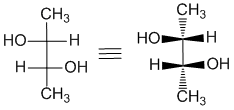
Here is an case of a Fischer diagram with the stereochemistry at 2 centers. It'southward the same idea, carbon chain vertical and the horizontal bonds towards y'all. 1 way to "decode" a Fischer project, is to draw in wedges and hashes to "reveal" the orientation of the bonds. This can help visualise the shape.
Drawing Cyclohexanes
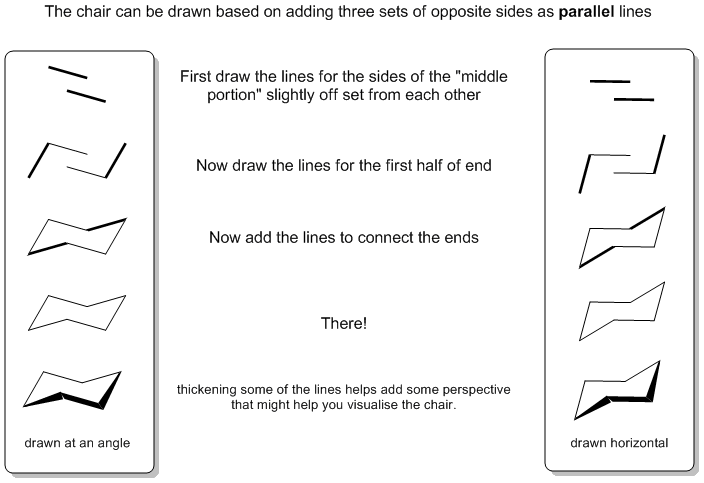
Drawing cyclohexane so that it looks like a chair can be the key to affectionate the difference between the axial and equatorial positions. If you are unable to draw good looking structures that conspicuously show centric and equatorial positions, and then your teacher is probably going to presume that yous don't know.
By non mastering the trick of drawing cyclohexanes the merely person that actually suffers is you the educatee. You deprive yourself of the cognition and the chance to capeesh it, what it ways and most chiefly what it can tell you. Believe me, it will exist needed later.
The commencement step is drawing the chair itself. Although the chair "looks improve" when slightly angled, it maybe easier to "learn" to draw information technology with the middle portion horizontal.
| |  |


How Do You Draw Double Bonds In Wedge And Dash,
Source: https://www.chem.ucalgary.ca/courses/351/Carey5th/Ch03/ch3-0-2.html
Posted by: strongpressessidow1985.blogspot.com
0 Response to "How Do You Draw Double Bonds In Wedge And Dash"
Post a Comment